


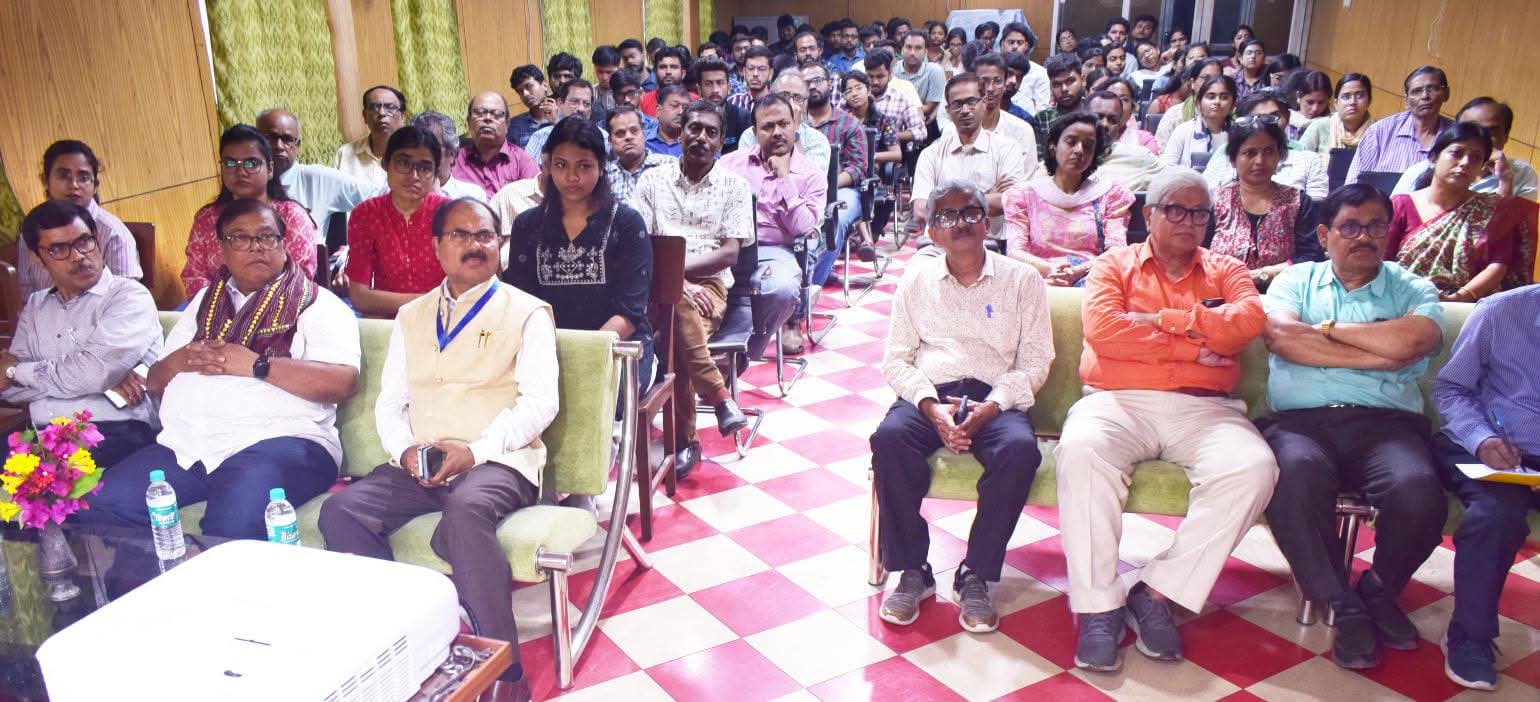


Special Reporter: An insightful programme on plant protection was organized at Bidhan Chandra Krishi Viswavidyalaya (BCKV) on 24th March 2026. The programme featured a highly engaging lecture by Prof. P. K. Chakrabarty, Chief Scientific Advisor, R&D, Dhanuka Agritech and Former Member, ASRB, and Former ADG (Plant Protection & Biosafety), ICAR, New Delhi
In his introductory remarks, Dr. Ashok K. Patra, Vice-Chancellor, emphasized that plant protection remains central to ensuring food and nutritional security under increasing biotic and climatic stresses. He highlighted the need to minimize crop losses through scientific pest management while ensuring safe and judicious pesticide use to protect environmental and human health.
Prof. Chakrabarty’s lecture focused on transformative regulatory and scientific approaches, particularly crop grouping and harmonisation of Maximum Residue Limits (MRLs) as practical solutions to the persistent challenge of pesticide off-label use. He noted that in India, a large proportion of crops, especially high-value, low-volume crops, lack registered pesticide labels, compelling farmers toward off-label applications, which in turn create food safety and trade risks.
Drawing from a recent policy paper developed by the National Academy of Agricultural Sciences based on a workshop recently convened by him, he explained that crop grouping enables extrapolation of residue data from representative crops to related member crops within a group, thereby significantly reducing the need for costly and time-consuming individual registrations. This approach allows group MRLs to be established, ensuring regulatory coverage across a wide range of crops with limited data generation, while remaining aligned with Codex principles. He further emphasized that such harmonisation could convert off-label use into regulated and scientifically validated use, improving compliance with domestic food safety standards and international trade requirements. By reducing the number of required MRLs through grouping, the approach offers a cost-effective pathway to expand label claims, enhance availability of crop protection solutions, and minimize export rejections due to residue violations.
Prof. Chakrabarty also underscored the importance of policy support, classification of major and minor crops, and institutional collaboration for implementing crop grouping frameworks. Adoption of globally harmonized practices, strengthening residue data generation, and alignment with Codex standards were highlighted as essential steps toward enhancing India’s competitiveness in global agricultural trade. The lecture concluded with a call for integrated efforts among policymakers, scientists, and industry to build a science-based, economically viable, and globally harmonized plant protection system that ensures both food safety and sustainable agricultural growth.
The programme was excellently anchored by Prof. Pintoo Bandyopadhyaya, Head, Department of Agronomy. Dr Subroto Datta, Prof Plant Pathology and Dr Raghunath Mandal, organised effective coordination to arrange this special lecture related to plant protection. The event was attended by Prof. S. B. Goswami, Registrar, BCKV; Prof. S. Mukherjee, Director of Research, BCKV; and Dr. P. K. Mani, Dean, Faculty of Agriculture. Faculty members and students from the Departments of Agronomy, Agricultural Entomology, Plant Pathology, and Agricultural Chemicals actively participated, reflecting strong interdisciplinary engagement.
The seminar concluded with an engaging discussion, reaffirming the importance of integrating scientific innovation, regulatory foresight, and environmental stewardship to build resilient and sustainable food systems.
